
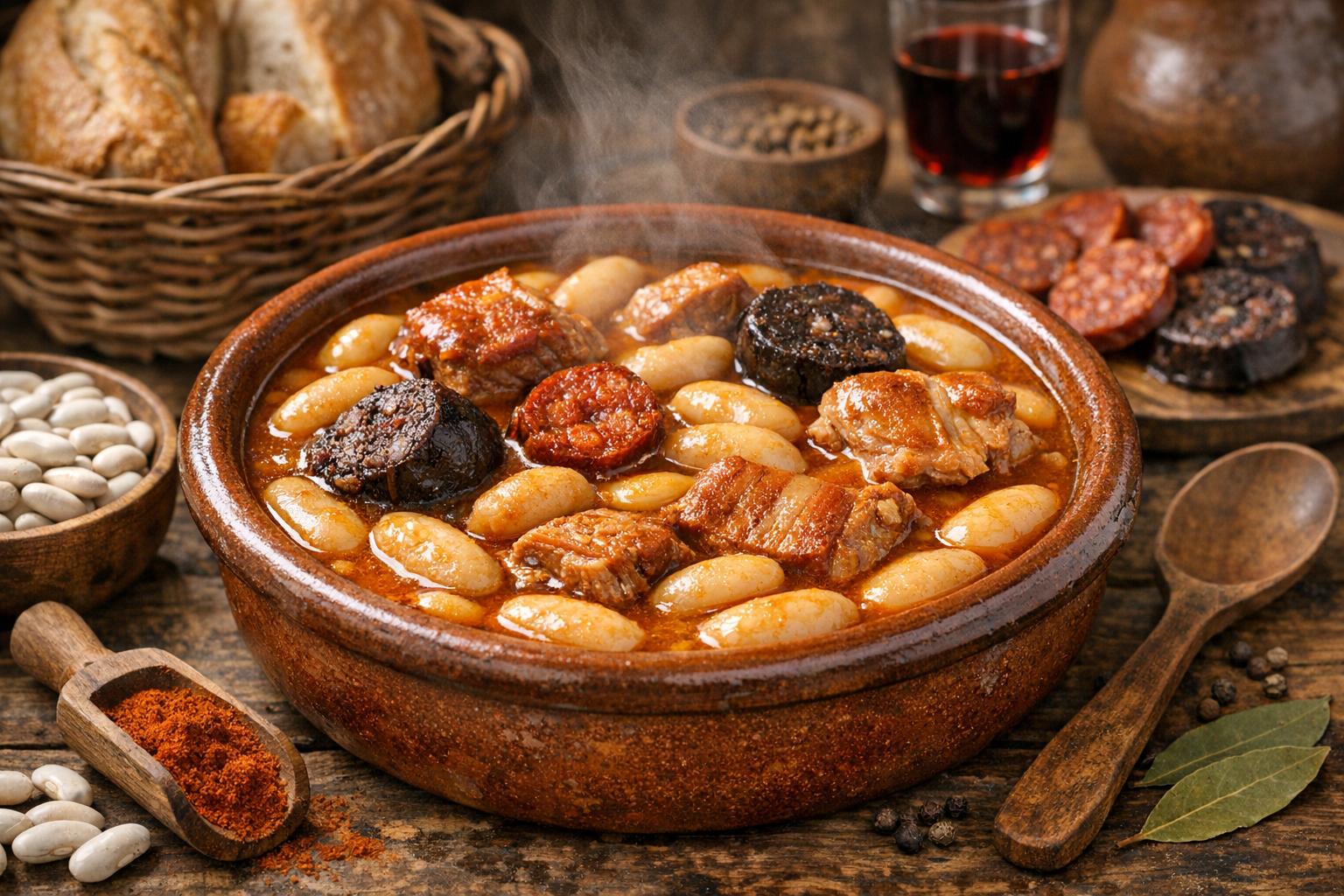
Fabada Asturiana is a traditional Spanish bean stew originating from the autonomous community of Asturias in northern Spain. Recognized as one of the most emblematic dishes of regional Spanish cuisine, it reflects the agricultural practices, climate, and culinary preferences of the area. Asturias, characterized by its green landscapes, mountainous terrain, and proximity to the Cantabrian Sea, has long relied on hearty, nourishing dishes suited to cooler and wetter weather. Fabada Asturiana developed within this context as a substantial meal designed to provide sustained energy and comfort during long winters.
The dish is built upon a small number of high-quality ingredients that are carefully prepared and slowly cooked to achieve a unified and balanced result. Although simple in composition, the stew is valued for the depth that emerges from patient cooking and attention to raw materials. Over time, Fabada Asturiana has moved beyond regional boundaries and is now considered a significant representative of Spanish gastronomy as a whole.
The origins of Fabada Asturiana are closely tied to rural life in Asturias. Beans became common in Spanish cooking after their introduction from the Americas in the 16th century. Over the centuries, local farmers cultivated varieties particularly suited to the Asturian climate. Among these, large white beans known as fabes became central to regional cuisine.
Pork husbandry also played an essential role in the rural economy. Families traditionally raised pigs that were slaughtered annually, with every part carefully preserved or cured. Sausages such as chorizo and morcilla, along with cured pork belly and ham, became staple ingredients in many homes. Fabada Asturiana emerged as a practical and efficient way to combine preserved meats with locally grown beans, creating a meal that maximized available resources.
By the 19th and early 20th centuries, the dish was more widely recognized in urban centers within Asturias. Restaurants and cider houses began serving it as a substantial midday meal, reinforcing its association with regional identity. Today, it appears both in home kitchens and in professional culinary settings, ranging from traditional taverns to fine dining establishments.
The defining characteristic of Fabada Asturiana lies in the quality and interaction of its principal components. Though the ingredient list is relatively concise, each element carries specific importance.
The foundation is the white bean known as faba asturiana. These beans are typically large, oval-shaped, and thin-skinned. Their texture, once cooked, is smooth and creamy without becoming grainy. This contributes to the stew’s signature consistency, in which the cooking liquid thickens naturally through the gradual release of starch from the beans.
Accompanying the beans is a selection of pork products collectively referred to as the compango. This assortment traditionally includes chorizo, morcilla, and pancetta or cured pork belly. In some cases, ham bone or other cured cuts may be added to deepen the overall flavor.
The fabes used in Fabada Asturiana are central not only for substance but also for texture. Their capacity to absorb liquid while maintaining structural integrity makes them particularly suitable for extended simmering. A well-cooked bean in this dish should be tender throughout, with a delicate outer skin that remains intact rather than splitting apart.
The cultivation of faba asturiana has achieved protected designation of origin status in Spain. This certification underscores the importance of soil conditions, climate, and traditional farming methods in producing beans of the required quality. Although similar white beans can be substituted, purists often emphasize the difference in texture and flavor when authentic Asturian beans are used.
Prior to cooking, dried beans are soaked in cold water for an extended period, typically overnight. This rehydration step promotes even cooking and reduces the risk of uneven textures. Soaking also shortens total cooking time and supports the gradual development of the stew’s creamy consistency.
The pork components serve multiple functions. Chorizo introduces paprika-based seasoning, which lends a mild smokiness and subtle warmth. The level of spice remains moderate, ensuring that the beans remain the central focus. Morcilla, a type of blood sausage often prepared with rice or onion, contributes earthiness and depth. Pancetta or cured pork belly adds fat, which enriches the broth and creates a fuller mouthfeel.
As these meats simmer alongside the beans, they release seasoning and fat into the cooking liquid. Rather than overwhelming the stew, they integrate gradually. The resulting broth carries a balanced interplay of savory, smoky, and slightly sweet notes derived from pork and paprika.
After cooking, the meats are often sliced and served alongside or atop the beans. This presentation ensures that each serving reflects the traditional composition while allowing diners to experience the different textures separately and together.
The preparation of Fabada Asturiana relies on slow, controlled cooking. Traditionally, the ingredients are placed in a wide, heavy pot and covered with cold water. The contents are then brought slowly to a gentle simmer. Rapid boiling is avoided because agitation can cause the beans to break apart and release starch too quickly.
Throughout the cooking process, temperature regulation is essential. Gentle simmering encourages gradual softening of the beans and careful extraction of flavor from the meats. Periodic skimming removes excess foam and fat that rise to the surface. Some cooks add small amounts of cold water during simmering, a technique sometimes referred to as “frightening” the beans, in order to slow the boil and maintain tenderness.
The total cooking time can extend over several hours. In traditional settings, the stew might be prepared in the morning and allowed to cook steadily until midday. The result should be a thick, glossy broth in which the beans are fully cooked yet intact.
Preparation begins with careful inspection and rinsing of the dried beans to remove impurities. After soaking, they are drained and placed in the cooking vessel. The meats are typically added from the beginning rather than browned separately. This approach supports a uniform infusion of flavor and aligns with regional custom.
Seasoning is often minimal. Salt is used sparingly at the start, as the cured meats already contain significant salinity. Adjustments are made near the end of cooking, once the flavors have fully developed. Additional spices are generally limited in order to preserve the clarity of the core ingredients.
Low, steady heat defines the character of Fabada Asturiana. The stew is neither stirred vigorously nor rushed. Instead, gentle movement of the liquid ensures even cooking. Over time, rendered pork fat emulsifies with bean starch, naturally thickening the broth without added flour or artificial thickeners.
When properly prepared, the final consistency is neither watery nor excessively dense. The beans should appear suspended in a cohesive sauce that clings lightly without becoming pasty. The meats, once removed and sliced, remain tender and flavorful.
Although the core structure of Fabada Asturiana remains stable, subtle variations can be found throughout Asturias and beyond. Some cooks incorporate a small amount of saffron, which introduces a faint aromatic dimension and a slight golden hue. Others may add bay leaf or mild local sausages to adjust flavor complexity.
Differences also arise in proportions. Certain versions emphasize a higher ratio of beans to meat, highlighting the agricultural origins of the dish. Others increase the quantity of compango, producing a more intensely savory result. These adaptations reflect household preferences rather than strict rules.
Outside Asturias, cooks sometimes substitute locally available white beans or adapt the meat selection. While these variations may depart from protected regional standards, they demonstrate the adaptability of the dish’s underlying concept.
Fabada Asturiana is traditionally served as a main course, often forming the centerpiece of a midday meal. The stew is presented hot, with beans ladled into shallow bowls and sliced meats arranged either within the dish or on a separate platter. The substantial nature of the stew typically eliminates the need for additional courses.
Crusty bread accompanies the meal, providing contrast in texture and serving as a vehicle for the thickened broth. Regional beverages such as Asturian cider frequently accompany the dish. Full-bodied red wines are also common, selected to complement the savory richness of the pork and beans without overpowering them.
In many households and restaurants, Fabada is prepared in larger quantities and reheated the following day. The flavors often continue to integrate during rest, resulting in a slightly deeper taste after reheating.
Fabada Asturiana represents more than sustenance; it embodies regional continuity and shared practices. Culinary schools in Asturias teach its preparation as part of foundational regional training. Festivals and gastronomic events throughout the region frequently highlight the dish, reinforcing its cultural role.
The structured simplicity of the recipe allows it to be passed from one generation to the next with relative consistency. While modern cooking methods such as pressure cookers or induction stoves may alter the mechanics of preparation, the essential components and values remain intact. Respect for ingredient quality and patient cooking continue to define authentic versions.
Fabada Asturiana stands as a significant example of how regional ingredients, climate, and historical practice shape culinary tradition. Built upon fabes and a carefully selected assortment of pork, the stew exemplifies balance achieved through slow cooking and restraint in seasoning. Its development from rural necessity to emblematic regional dish illustrates the broader evolution of Spanish gastronomy.
Through attention to bean quality, thoughtful preparation of meats, and steady simmering, Fabada Asturiana achieves a unified character that has endured for generations. Whether served in a rural home, a traditional cider house, or an urban restaurant, it continues to reflect the agricultural heritage and culinary discipline of northern Spain.