
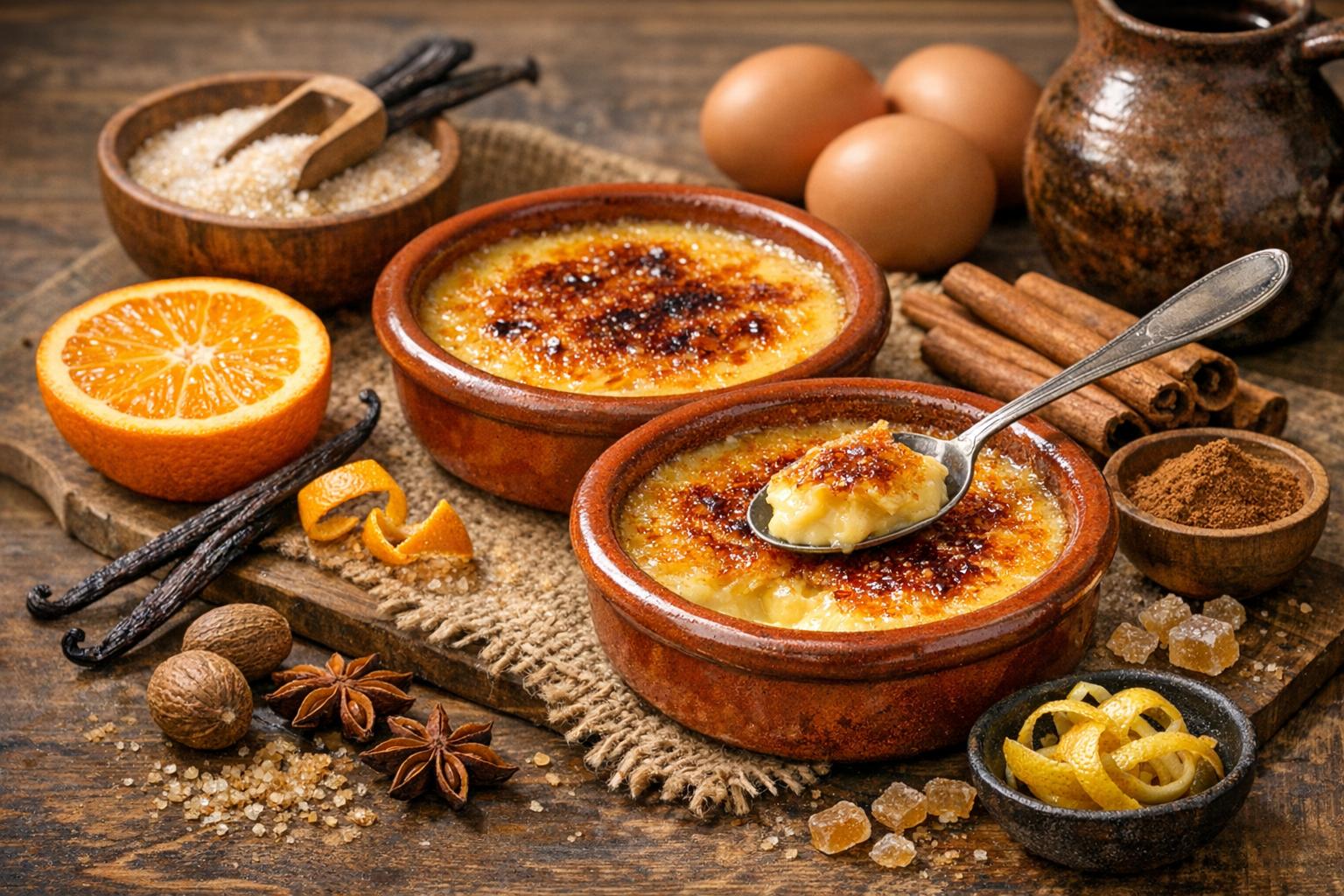
Crema Catalana, often referred to as Catalan custard, is a traditional Spanish dessert characterized by its smooth texture and balanced contrast between creamy custard and caramelized sugar. It occupies a significant place in the culinary traditions of Catalonia, a region in northeastern Spain with a distinct cultural and gastronomic identity. Although it is frequently compared to the French crème brûlée, crema catalana has its own historical development, ingredient composition, and preparation methods that distinguish it clearly from similar desserts.
This custard-based dessert demonstrates the long-standing European practice of combining dairy, eggs, and sugar to create stable, spoonable creams. Over time, regional variations emerged, shaped by local agricultural products and culinary customs. In Catalonia, the addition of citrus zest and cinnamon became defining features. As a result, crema catalana reflects both Mediterranean influences and local tastes, offering a flavor profile that is aromatic yet restrained.
Traditionally served on specific feast days, particularly on Saint Joseph’s Day, crema catalana also carries cultural and celebratory significance. Its preparation and presentation have been refined over generations, making it a dessert associated with both home kitchens and professional pastry establishments. Today, it is widely available throughout Spain and recognized internationally as representative of Catalan cuisine.
The custard base of crema catalana relies on a limited yet carefully balanced set of ingredients: milk, egg yolks, sugar, and cornstarch. Each element plays a functional role in achieving the dessert’s characteristic consistency and flavor. Milk provides the primary liquid structure and contributes a moderate richness without heaviness. Unlike cream-based custards, this reliance on milk produces a lighter texture. Egg yolks act as thickening agents and contribute color and smoothness. Sugar sweetens the mixture and later forms the caramelized topping, while cornstarch stabilizes the custard, ensuring a firm yet creamy finish.
Preparation typically begins by gently heating the milk with aromatic ingredients. This stage allows flavors to infuse while preventing scorching. Separately, egg yolks are combined with sugar and cornstarch until smooth. The warm milk is gradually incorporated into the egg mixture in a controlled process to avoid curdling. The combined mixture is then returned to the stovetop and cooked over moderate heat, stirred continuously until thickened. This stovetop method differs significantly from desserts baked in an oven.
Once thickened, the custard is poured into shallow individual dishes. It is then cooled to set completely before the final step: caramelization. A thin, even layer of sugar is sprinkled across the surface. Traditionally, a specially heated iron disk was pressed onto the sugar to create a brittle, caramelized crust. In modern kitchens, a culinary torch is commonly used to achieve the same effect. The result is a thin, glass-like caramel layer that cracks when tapped with a spoon.
One of the defining characteristics of crema catalana is the infusion of aromatic ingredients into the milk. This step distinguishes it from other custards that rely solely on vanilla for flavor. The infusion process typically includes cinnamon, lemon or orange zest, and sometimes vanilla. Each component contributes a distinct quality.
Cinnamon introduces warmth and subtle spice. In Mediterranean cooking, cinnamon is frequently used in both savory and sweet dishes, and its presence in crema catalana aligns with regional flavor traditions. The spice is typically added in stick form during the milk-heating phase to ensure a gentle extraction of flavor without overpowering the custard.
Lemon or orange zest provides brightness and aromatic complexity. The citrus oils contained in the peel disperse into the milk as it heats, contributing a light fragrance and mild acidity that balances the sweetness of the custard. This citrus element differentiates crema catalana from many other European custards that lack this refreshing characteristic.
Vanilla may be used to complement the other flavors. While not always emphasized, it contributes a familiar depth and enhances the perception of sweetness. In traditional preparations, vanilla supports rather than dominates the overall profile.
The infusion is carefully monitored to prevent bitterness or excessive intensity. After the milk has absorbed the desired flavors, the aromatic solids are removed before the custard thickens. The result is a smooth cream that carries subtle notes of spice and citrus without visible particles.
Texture is central to the identity of crema catalana. The interior should be creamy and uniform, with enough firmness to hold its shape while remaining soft when spooned. Achieving this balance requires attention to heat control and proportion. Excessive heat can cause curdling, while insufficient thickening can result in a loose consistency.
The caramelized topping forms a thin, rigid layer that contrasts with the custard beneath. When the dessert is served, the surface remains intact until tapped. The cracking of the sugar creates a sensory transition from crisp to smooth. Proper caramelization requires even distribution of sugar and controlled heat application to avoid burning. The sugar should melt and darken to a golden amber tone without turning bitter.
Because crema catalana is not baked, its structure depends more heavily on starch stabilization compared to oven-set custards. Cornstarch reduces the likelihood of separation and contributes to the characteristic smoothness. The final texture should not resemble pudding but rather a firm custard capable of holding a spoon upright briefly when inserted.
Although crema catalana and crème brûlée share visual similarities, including a caramelized surface, their preparation methods and flavor compositions differ substantially. Crème brûlée typically uses heavy cream as its primary dairy component, resulting in a denser and richer custard. It is prepared by combining cream, egg yolks, and sugar, which are then baked in a water bath. The baking process ensures gentle, uniform cooking and produces a silky interior.
Crema catalana, by contrast, relies on milk rather than cream. This substitution reduces fat content and creates a lighter mouthfeel. Additionally, the inclusion of cornstarch adds structural stability without requiring oven baking. The stovetop method permits closer temperature control during thickening but demands careful stirring.
Flavor is another differentiating factor. Crème brûlée often emphasizes vanilla as the primary aromatic element. Crema catalana incorporates cinnamon and citrus zest, contributing complexity and brightness. These elements shift the sensory profile away from pure creaminess toward a more layered taste experience.
Serving temperature may also differ. While both desserts are generally chilled before caramelization, crema catalana is often perceived as slightly more refreshing, partly due to its citrus notes and lighter dairy base. These differences illustrate how similar culinary concepts diversify across regions.
Crema catalana holds a defined place within Catalan culinary tradition. Historically, it has been associated with the celebration of Saint Joseph’s Day on March 19, which coincides with Father’s Day in Spain. On this occasion, families traditionally prepare and share the dessert. Over time, it became integrated into restaurant menus and is now enjoyed year-round.
Its inclusion in festive meals reflects the agricultural patterns of the region. The primary ingredients—milk and eggs—were commonly available on farms, and sugar became more accessible as trade expanded. The use of citrus zest reflects Mediterranean cultivation, further rooting the dessert in its geographic origin.
Despite modernization, many households continue to prepare crema catalana according to inherited methods. Traditional terracotta dishes remain popular for serving, as their shallow shape maximizes the caramelized surface area. While stainless steel and porcelain alternatives are common in restaurants, the earthenware presentation remains closely associated with authenticity.
Crema catalana is typically served in individual shallow dishes, allowing each portion to develop a broad caramelized surface. Before serving, chefs ensure the sugar topping is freshly caramelized so that the crust remains crisp. If the dessert stands too long after torching, the sugar may absorb moisture and soften.
The dessert is generally served chilled, though not excessively cold, as extreme refrigeration can dull the aromatic qualities. Allowing the custard to rest briefly at room temperature enhances flavor perception. When the spoon breaks through the caramel layer, it should reveal a smooth and uniform custard beneath.
In dining settings, crema catalana often appears as a concluding course following savory dishes that highlight Mediterranean ingredients. Its moderate sweetness and citrus undertones make it compatible with a variety of meals. While it can be accompanied by coffee or dessert wine, it is frequently served on its own, allowing its textures and flavors to stand independently.
In contemporary culinary practice, variations may introduce subtle adaptations, such as alternative citrus combinations or adjustments in sweetness levels. However, the essential structure remains consistent: infused milk custard, chilled to set, topped with a crisp caramel layer. This adherence to core principles preserves the dessert’s identity while allowing flexibility in presentation.
Crema catalana continues to represent a convergence of simplicity and technique. Its limited ingredient list requires precise execution, and its success depends on proper handling of heat, texture, and timing. As part of Spanish gastronomy, it demonstrates how regional ingredients and preparation methods create distinctive results within a shared European dessert tradition.