
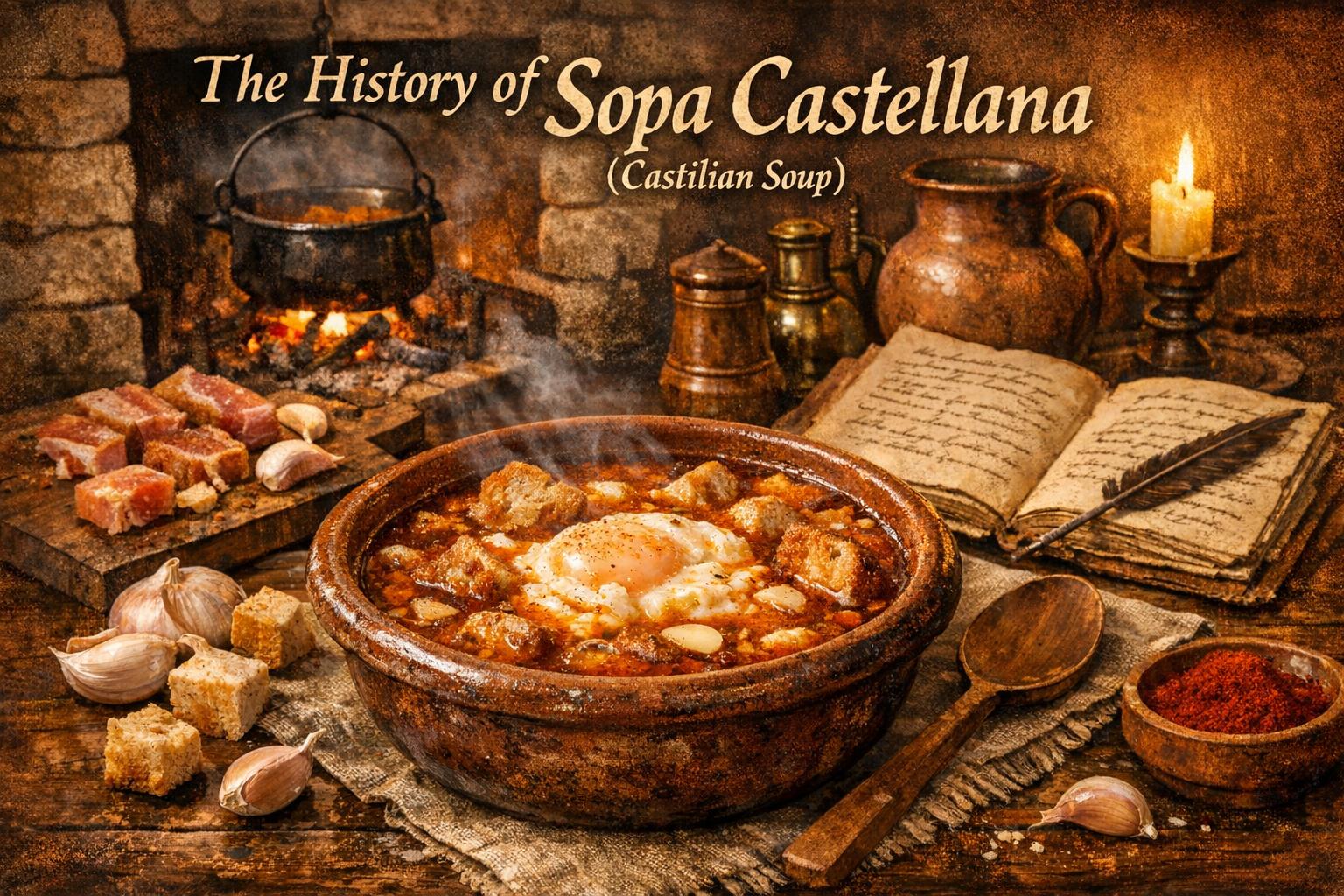
Sopa Castellana, also known as Castilian soup, is a traditional Spanish preparation whose history reflects the broader development of rural cuisine on the Iberian Peninsula. Its origins lie in the region of Castile, a vast plateau in central Spain characterized by harsh winters, dry summers, and an agricultural economy historically centered on cereals and livestock. The environmental conditions of Castile shaped its culinary traditions, favoring hearty, durable ingredients that could withstand storage and long transportation. Within this context, Sopa Castellana emerged as a practical and sustaining dish.
The earliest references to garlic and bread soups in Castile date back to the Middle Ages. During this period, bread was a primary dietary staple across Spain. It was consumed daily, and stale bread was rarely discarded. Instead, it was incorporated into various dishes designed to extend its usefulness. Soups thickened with bread were especially common among rural communities, where minimizing waste was essential. Sopa Castellana developed as one of these resourceful preparations, combining stale bread with water, garlic, olive oil, and occasionally animal products when available.
Castile was historically a land of shepherds, farmers, and soldiers. The mobility of shepherds, particularly during transhumance along established grazing routes, required food that was portable and adaptable. Dried bread, cured meats, garlic, and olive oil met these requirements. These same ingredients formed the structural base of Sopa Castellana. As Spain transitioned through various political and economic periods, including the consolidation of the Spanish kingdoms and later imperial expansion, the dish remained associated with rural life rather than courtly cuisine. Its endurance across centuries reflects its adaptability and relevance to daily subsistence.
Climatic conditions also contributed to its development. The cold winters of the Castilian plateau called for warming meals that could be prepared over a simple fire. A pot of soup simmering slowly with bread and garlic provided substantial nourishment with limited expense. The practicality of the dish anchored it firmly within the domestic traditions of the region.
The defining characteristic of Sopa Castellana is its reliance on a small number of accessible ingredients. The foundation typically consists of stale bread, garlic, olive oil, paprika, water or broth, and eggs. Each component plays a functional role in creating both flavor and texture.
Bread serves as the structural base of the soup. Traditionally, dense country bread with a firm crust and substantial crumb was preferred. When stale, this bread absorbs liquid without disintegrating entirely, allowing the soup to achieve a thick consistency. The use of stale bread reflects long-standing culinary practices rooted in economy and sustainability.
Garlic is another essential ingredient. It is usually sliced and gently sautéed in olive oil at the beginning of preparation. This initial step infuses the oil with aromatic qualities that define the flavor of the finished dish. Spanish olive oil, particularly from central and southern regions, contributes not only fat for cooking but also depth and subtle bitterness.
Paprika, known in Spain as *pimentón*, is a significant addition that distinguishes Sopa Castellana from other European bread soups. Spanish paprika can range from sweet to smoked. The smoked variety, often associated with the region of Extremadura, imparts a characteristic color and mild smoky undertone. Paprika was introduced to Spain following contact with the Americas in the late fifteenth and early sixteenth centuries. Over time, it became fully integrated into regional cuisines, including that of Castile.
Water or broth is added once the garlic and paprika have been lightly cooked. In humbler versions, water suffices, while richer variants may incorporate meat stock. The bread is then added and allowed to soften and release starches, which thicken the liquid. The soup cooks slowly, allowing the flavors to blend without aggressive boiling.
Eggs are typically introduced toward the end of the process. They may be poached directly in the simmering broth or beaten lightly and stirred in to create delicate ribbons. The addition of eggs increases the protein content of the dish, transforming it from a simple broth-based preparation into a more complete meal. In many households, the egg provides the finishing element that signals readiness for serving.
The preparation does not require advanced technical skill but demands attention to proportion and heat control. Excessive heat can cause the paprika to become bitter or the bread to disintegrate completely. Proper balance results in a soup that is thick but not pasty, aromatic without being overpowering, and cohesive in texture.
Although the essential structure of Sopa Castellana has remained consistent, the recipe has evolved in response to changing economic conditions, ingredient availability, and regional preferences. As Spanish society gradually improved in economic stability, especially during the nineteenth and twentieth centuries, households gained access to a wider range of ingredients. These additions enriched the previously austere preparation.
One common enhancement is the inclusion of jamón serrano, a dry-cured ham deeply embedded in Spanish culinary identity. Small cubes of ham sautéed with the garlic introduce saltiness and depth. In some regions, chorizo is added, contributing both paprika seasoning and rendered fat. These ingredients transform the soup into a more substantial dish, suitable for serving as a principal course rather than a modest starter.
Vegetables have also found their way into certain interpretations. Onions may accompany the garlic to add sweetness. In some cases, leafy greens or small amounts of tomato are incorporated. These modifications reflect both local agricultural patterns and personal taste. However, such additions remain supplementary rather than central, as the defining elements of bread, garlic, oil, and paprika persist.
The evolution of Sopa Castellana also mirrors historical shifts in Spanish society. During periods of hardship, such as the Spanish Civil War and the subsequent years of scarcity, simple soups regained prominence due to rationing and limited resources. In more prosperous decades, richer versions became common, particularly in restaurants that presented traditional cuisine within a modern dining context.
In contemporary culinary practice, chefs may reinterpret Sopa Castellana using refined techniques. Bread might be toasted for additional texture, eggs prepared with precision, and broth clarified. Nevertheless, the flavor profile remains rooted in its rustic origin. The balance between maintaining authenticity and accommodating innovation continues to shape the dish’s development.
Sopa Castellana occupies a distinct place within Spanish food culture. It represents an approach to cooking defined by efficiency, practicality, and respect for ingredients. The use of stale bread is not merely an economic necessity but a cultural expression of avoiding waste. This practice aligns with broader Mediterranean culinary patterns, where resource management has long influenced daily meals.
The soup also reflects the social structures of rural Castile. Historically, meals were centered around communal consumption. A large pot of soup could feed multiple family members or laborers working in the fields. The dish required ingredients commonly found in rural households, reinforcing shared culinary identity across villages and towns.
Religious practices played a role in shaping Spanish cuisine, and Sopa Castellana fits within this framework. During periods of religious observance when meat consumption was limited, simple soups provided sustenance without violating dietary guidelines. Even in versions containing ham or chorizo, the quantities were often small, functioning more as seasoning than primary protein.
The preparation of Sopa Castellana also demonstrates the integration of products originating outside Spain. Paprika, derived from New World peppers, became essential to the dish. Its incorporation illustrates how Spanish cuisine absorbed global influences while maintaining regional distinctions.
In modern Spain, discussions surrounding traditional foods often center on preservation of heritage. Sopa Castellana is frequently cited as an example of a dish that embodies historical continuity. Culinary schools and cultural institutions study such recipes not only for their flavor but for what they reveal about agricultural systems, trade networks, and social organization.
Today, Sopa Castellana continues to be prepared in both domestic kitchens and professional establishments. Its presence is particularly noticeable during colder months, when substantial soups align with seasonal preferences. In restaurants specializing in regional cuisine, it may appear as an introductory course that sets the tone for a meal focused on Castilian traditions.
In household settings, the recipe varies according to family preferences. Some cooks maintain a strictly traditional approach, using minimal ingredients and preparing the soup in earthenware pots. Others adapt the recipe for convenience, employing pre-sliced bread or commercially produced broth. Despite such variations, the essential method remains recognizable.
The broader interest in sustainable cooking has contributed to renewed appreciation for dishes like Sopa Castellana. Contemporary discussions about reducing food waste often highlight recipes that utilize leftover bread. As a result, the soup serves as an example of long-standing practices that align with modern sustainability principles.
Culinary media and resources also contribute to the dish’s ongoing relevance. Numerous recipes and instructional guides provide variations suited to different tastes and dietary needs. Some adaptations reduce fat content, while others enhance richness. These modern presentations preserve the structure of the original while adapting to changing expectations.
In Spain, regional identity remains strong, and food plays a central role in expressing this identity. Sopa Castellana continues to function as a marker of Castilian heritage. Although it originated in a specific geographic context, its recognition now extends nationwide. It is considered part of the broader repertoire of traditional Spanish soups, alongside gazpacho, caldo gallego, and other regional specialties.
Internationally, the dish has gained modest recognition through Spanish restaurants and culinary publications. Its simplicity makes it accessible to cooks outside Spain, while its distinctive use of paprika and garlic offers a clear connection to Spanish flavor profiles. However, outside its region of origin, it is often categorized broadly as a garlic soup, which may obscure the cultural and historical dimensions embedded in its name.
The endurance of Sopa Castellana can be attributed to its adaptability. While economic conditions, ingredient access, and culinary tastes have changed significantly since its inception, the dish remains relevant because it answers consistent needs: nourishment, efficiency, and clarity of flavor. Its historical association with rural life does not confine it to the past; rather, it provides context for understanding contemporary appreciation of traditional foods.
In examining Sopa Castellana across centuries, one observes a pattern of continuity supported by moderate adaptation. The essential structure established in Castile—bread softened in broth, seasoned with garlic and paprika, enriched with egg—persists. Surrounding this foundation, variations emerge according to circumstance. This balance between stability and flexibility explains the dish’s presence in both historical records and modern kitchens.
Sopa Castellana therefore functions as more than a regional recipe. It serves as a reflection of Spanish culinary development, agricultural patterns, and social resilience. Its history demonstrates how modest ingredients can produce a dish of lasting significance. Through ongoing preparation and reinterpretation, the soup continues to connect present-day Spain with its Castilian roots.