
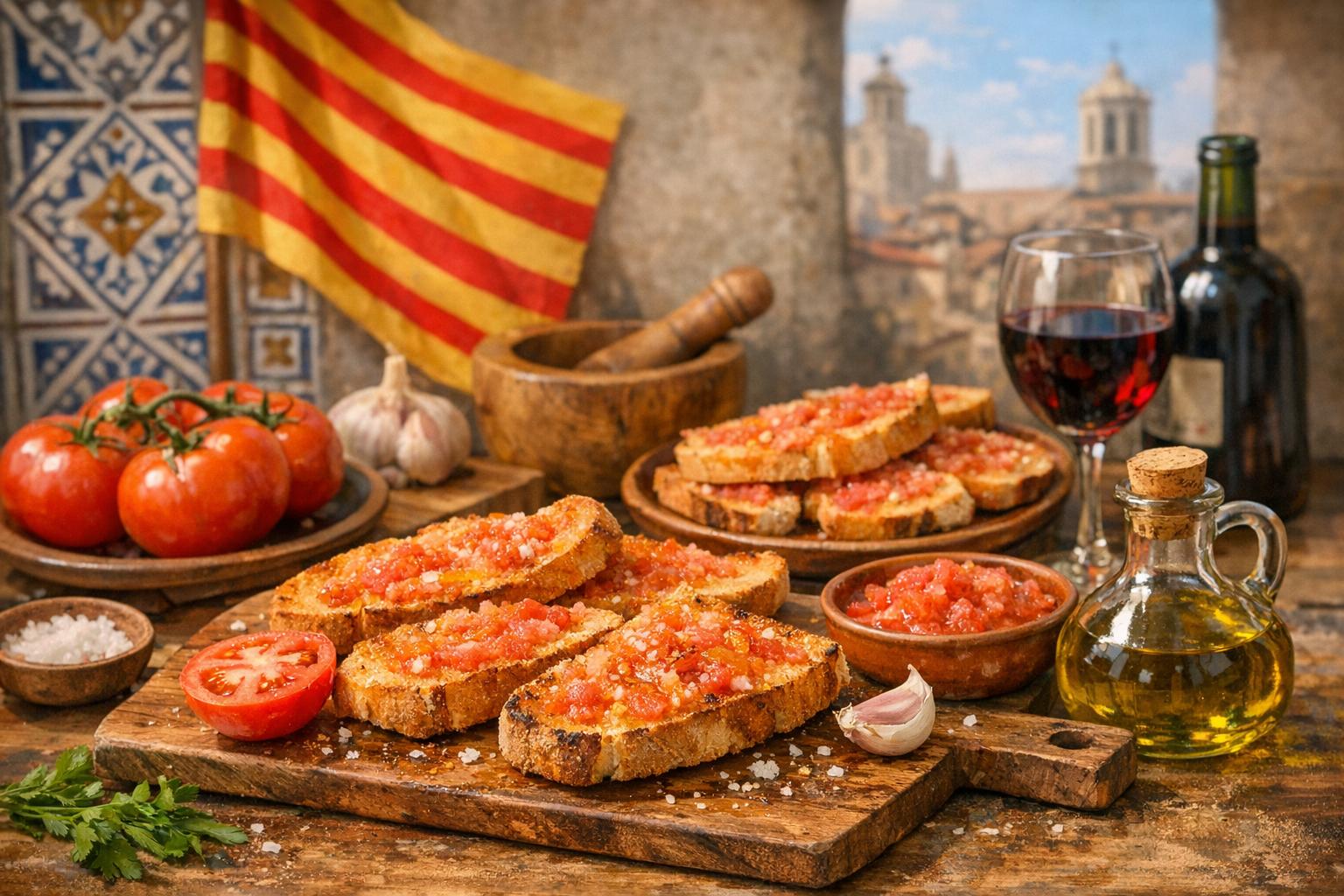
Pan con tomate, known in Catalan as pa amb tomàquet, is a traditional preparation that occupies a central place in Spanish culinary practice, particularly in the northeastern region of Catalonia. Although today it appears on restaurant menus and in international cookbooks, the dish began as a practical solution developed in rural households. Its basic composition—bread, ripe tomato, olive oil, and salt—reflects the agricultural landscape of Mediterranean Spain and the economic realities of earlier centuries.
The widely accepted account of its beginnings situates pan con tomate in the countryside during the nineteenth century, after tomatoes had become fully integrated into Spanish agriculture. Farmers and laborers often relied on bread as a dietary staple. When bread hardened after several days, rubbing it with ripe tomato provided moisture and renewed palatability. The addition of olive oil, another essential product of the region, improved texture and caloric content. Salt enhanced flavor and contributed to preservation. This straightforward technique exemplifies how necessity shaped everyday cooking practices.
The tomatoes used were not incidental to the dish’s success. Local varieties, adapted to the Mediterranean climate, produced fruit that was soft, juicy, and rich in flavor when fully ripe. The method of rubbing the cut surface of the tomato directly onto the bread allowed the pulp and juice to be absorbed without introducing excessive liquid. Over time, this approach became standardized in many Catalan homes.
As transportation networks expanded and urbanization accelerated in the late nineteenth and early twentieth centuries, rural food traditions followed people into cities. Pan con tomate moved from farmhouse kitchens to urban apartments and cafés. Despite changes in context, its preparation remained largely consistent. The dish’s endurance reflects both its simplicity and its compatibility with a broad range of meals.
Although Catalonia is most closely associated with pan con tomate, variations exist throughout Spain. In Catalonia, the bread is typically a rustic loaf with a firm crust and open crumb structure. The bread may be lightly toasted to create a contrast between crisp exterior and tender interior. A clove of garlic is sometimes rubbed onto the still-warm surface before the tomato is applied, though this step is not universal. The tomato is cut in half and pressed against the bread, allowing friction to release the pulp while leaving the skin behind.
The variety known as tomate de colgar is often cited as especially suitable for traditional preparation. These tomatoes are harvested in late summer and hung in clusters to preserve them for months. Their texture becomes soft yet concentrated over time, making them ideal for spreading onto bread. This practice reflects a broader pattern in Mediterranean societies of preserving seasonal produce for extended use.
In other parts of Spain, including Andalusia and Madrid, modifications of the method appear. Instead of rubbing the tomato directly onto the bread, some cooks grate the tomato into a coarse purée and spoon it over toasted slices. This technique creates a thicker layer and a more uniform distribution. In certain establishments, especially in urban cafés serving breakfast, the grated tomato is presented separately, allowing diners to assemble the dish themselves.
The choice of bread also varies according to regional availability. While traditional Catalan loaves are common in northeastern Spain, elsewhere cooks may use baguettes, country-style bread, or other crusty varieties. The essential requirement is structural integrity so the bread can support moisture without becoming overly saturated. Regardless of regional interpretation, the essence of the dish remains defined by its restraint and by the interaction of high-quality, minimally processed ingredients.
Olive oil plays a critical role in unifying these components. Extra virgin olive oil is typically preferred because of its aromatic qualities and balanced bitterness. The oil should be drizzled evenly, not poured excessively, so that it complements rather than overwhelms the tomato. Salt, often sea salt, is sprinkled sparingly to enhance the natural sweetness and acidity of the fruit.
Temperature and timing contribute to the outcome. Bread that is too cold may resist absorption, while bread that is too hot can cause the tomato to lose freshness. Ideally, the preparation is assembled immediately before serving to preserve texture and prevent sogginess. These considerations demonstrate that, although the recipe is simple, execution requires attention.
Pan con tomate functions as more than a culinary technique; it represents a shared food culture. In Catalonia, it frequently appears alongside daily meals rather than as a standalone dish. It accompanies grilled meats, stews, and seafood, serving as both side and utensil. The act of rubbing tomato onto bread at the table reinforces its role as a communal preparation.
Breakfast customs in many parts of Spain incorporate pan con tomate. When served in the morning, it may be paired with coffee and sometimes with cured ham or cheese. In tapas culture, smaller portions appear as part of a broader assortment. Its presence in these contexts reflects its adaptability rather than a shift away from tradition.
The preparation also aligns with the principles commonly associated with the Mediterranean diet. Fresh produce, olive oil as the primary fat, and moderate portions define this dietary pattern. Pan con tomate exemplifies how these elements combine in daily practice. Its nutritional profile, emphasizing carbohydrates, monounsaturated fats, vitamins, and antioxidants, corresponds to research highlighting the benefits of Mediterranean eating habits.
Beyond nutrition, the dish holds symbolic value within regional identity. In Catalonia, serving pa amb tomàquet is often viewed as an affirmation of local heritage and language. Cookbooks and culinary institutions in the region regularly include it as a foundational preparation. Public events and festivals may incorporate demonstrations of traditional methods, reinforcing its continuity across generations.
Despite its modest origins, pan con tomate has achieved a degree of formal recognition in professional kitchens. Chefs may refine the method by selecting heirloom tomato varieties, adjusting the cut of bread, or controlling olive oil acidity. Even in these contexts, however, the preparation retains its defining restraint. Innovation tends to focus on refinement rather than transformation, ensuring that the core components remain intact.
As Spanish cuisine gained international visibility in the late twentieth and early twenty-first centuries, pan con tomate traveled alongside it. Restaurants outside Spain began incorporating tapas-style offerings, and bread with tomato became a frequent inclusion. In these new environments, ingredients are often adapted to local markets. Tomatoes grown in different climates may vary in sweetness and acidity, requiring adjustments in seasoning.
Some contemporary interpretations experiment with presentation. Instead of rustic slices, chefs may use smaller crostini as bases for bite-sized portions. Others strain grated tomato to remove excess liquid, creating a more concentrated topping. While these adaptations alter surface characteristics, they generally preserve the combination of bread, tomato, oil, and salt that defines the dish.
In domestic settings outside Spain, pan con tomate often becomes a practical option for light meals. Home cooks may incorporate additional elements such as sliced avocado, anchovies, or roasted peppers. Although these additions expand the flavor profile, the foundational layer of tomato and olive oil remains identifiable. The dish’s open structure facilitates variation without losing coherence.
The global spread of Mediterranean cuisine has also influenced ingredient sourcing. Olive oils from different producing countries introduce distinct sensory attributes. Bread styles from various culinary traditions shape texture. Tomatoes bred for durability rather than flavor can present challenges, leading some cooks to seek heirloom or vine-ripened varieties for improved results. These considerations illustrate how global distribution networks affect even the simplest preparations.
Commercial production has followed demand. Some food retailers sell packaged grated tomato or ready-to-use tomato purée intended specifically for bread. While convenient, these products diverge from the tactile practice of rubbing fresh tomato onto bread. The shift from direct preparation to pre-packaged components reflects broader changes in domestic cooking patterns.
The continued relevance of pan con tomate depends on the preservation of ingredient quality and culinary knowledge. As agricultural practices evolve, the availability of tomato varieties suitable for rubbing onto bread may fluctuate. Efforts to conserve regional cultivars, including tomate de colgar, contribute to maintaining traditional methods. Similarly, small-scale bakeries that produce crusty loaves support authenticity in preparation.
Educational initiatives, such as culinary schools and cooking workshops, frequently include pan con tomate in foundational curricula. By teaching proper technique, these programs ensure that the dish is not reduced to a simplified or diluted form. Documentation in cookbooks and gastronomy studies further supports its transmission.
At the same time, adaptation remains inevitable. Changing consumer preferences, dietary considerations, and technological advancements influence how the dish is prepared and consumed. For example, interest in whole-grain bread may alter texture and flavor. Advances in olive oil extraction methods can affect sensory qualities. Climate change may influence tomato cultivation patterns across Mediterranean regions.
Despite these variables, the structural simplicity of pan con tomate contributes to its resilience. Its reliance on accessible ingredients and minimal equipment makes it sustainable across diverse contexts. The fundamental technique—combining bread with ripe tomato and olive oil—requires little beyond attentiveness to quality.
In evaluating its broader significance, pan con tomate illustrates how food traditions develop from practical origins into cultural markers. What began as a method for utilizing stale bread now functions as a staple in homes, cafés, and restaurants both within Spain and internationally. Its profile has expanded, yet its preparation retains continuity with earlier generations.
The lasting importance of pan con tomate lies not in complexity but in consistency. Through adherence to seasonal produce, regional products, and straightforward technique, it represents an approach to cooking grounded in efficiency and respect for ingredients. As culinary trends continue to evolve, this dish provides a reference point for understanding how simplicity and quality can coexist within both traditional and modern frameworks.