
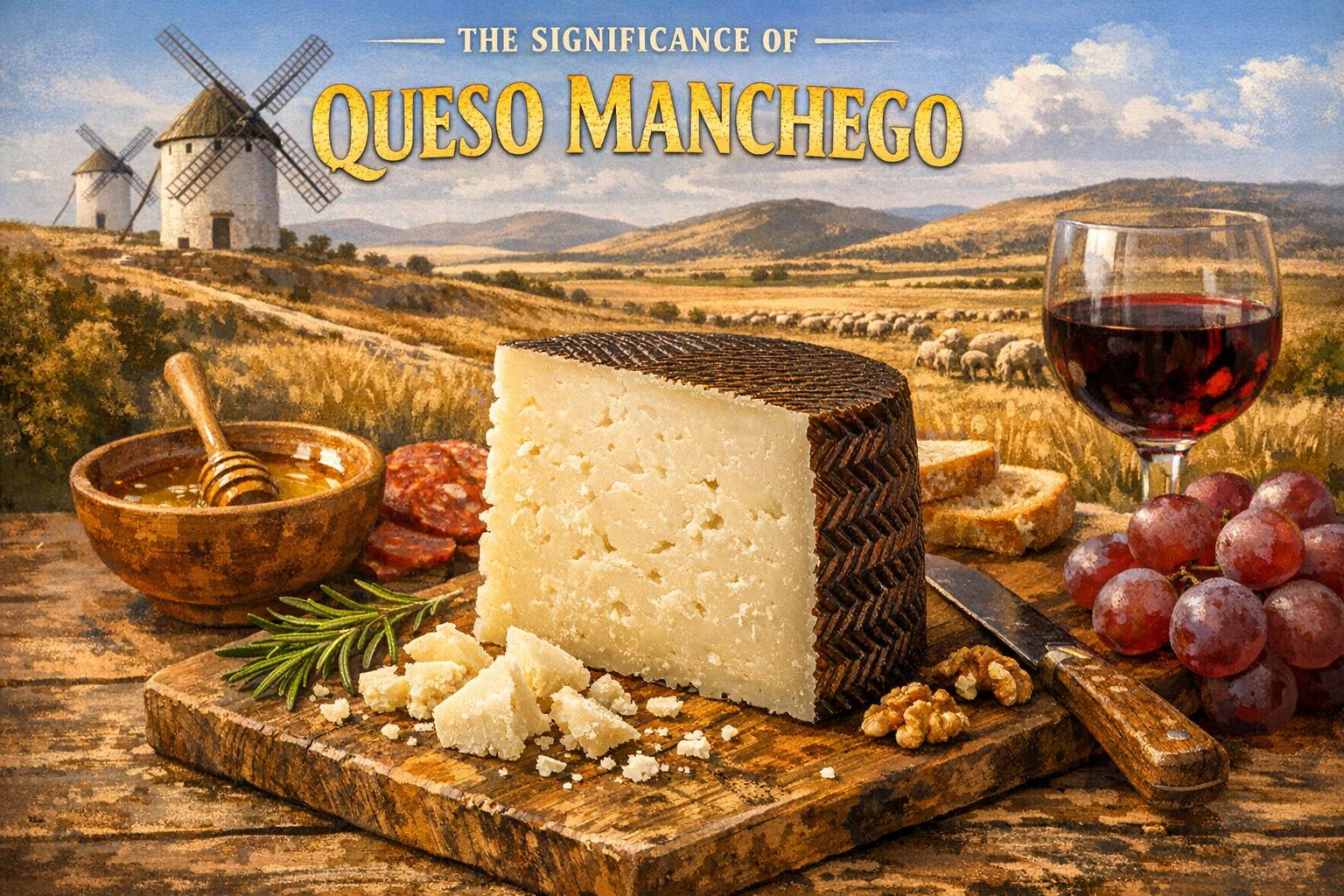
Queso Manchego, widely known as Manchego cheese, is one of Spain’s most established and internationally recognized cheeses. It originates from the autonomous community of Castilla–La Mancha, a vast central plateau characterized by dry plains, extreme seasonal temperatures, and a long pastoral history. The region’s landscape, marked by rolling fields and scattered windmills, has shaped not only its agriculture but also its gastronomic traditions. Among these traditions, the production of sheep’s milk cheese stands out as a defining element of local identity.
Historical records indicate that cheesemaking in La Mancha dates back thousands of years. Archaeological evidence suggests that early inhabitants of the Iberian Peninsula were already processing sheep’s milk into preserved forms suitable for long storage. Over time, methods evolved, but the reliance on sheep adapted to the harsh climate remained constant. The Manchega sheep breed, indigenous to the region, became central to the continuity of this practice. Its milk, rich in fat and protein, proved well suited for the development of firm, aged cheeses capable of maturing in variable conditions.
Today, Manchego cheese is protected under the European Union’s Protected Designation of Origin (PDO) system. This status ensures that any cheese labeled “Queso Manchego” must be produced within specified provinces of Castilla–La Mancha—Albacete, Ciudad Real, Cuenca, and Toledo—and must conform to stringent regulatory standards. These rules govern the breed of sheep used, the handling of milk, production techniques, and aging conditions. The PDO framework preserves traditional methods while providing consumers with authentication and traceability. It also distinguishes true Manchego from similarly styled cheeses produced elsewhere.
The heritage of Manchego is not limited to its regulations. The cheese has woven itself into the cultural and literary fabric of Spain. It is famously referenced in Miguel de Cervantes’ Don Quixote, reflecting its common presence in the rural diet of the early 17th century. While culinary tastes have evolved, the cheese remains closely associated with the everyday life of La Mancha, where sheep farming continues alongside modern agricultural industries.
The defining qualities of Queso Manchego are inseparable from the environmental context of La Mancha. The region sits at a considerable altitude and experiences hot summers, cold winters, and low annual rainfall. The natural vegetation is composed largely of hardy shrubs, grasses, and aromatic plants such as thyme and rosemary. These plants form the basis of the Manchega sheep’s diet, either through grazing or in preserved fodder.
Sheep husbandry in this environment has historically required resilience and mobility. Flocks were often moved seasonally to take advantage of available pastures, a practice linked to Spain’s broader tradition of transhumance. Though modern farming methods have introduced controlled feeding and improved veterinary management, many herds still rely on regional forage that influences the composition and flavor of the milk. The relationship between pasture, animal, and finished cheese remains a defining characteristic of Manchego.
Milk Source: Authentic Manchego is produced exclusively from the milk of the Manchega sheep. This breed has evolved over centuries to thrive in the semi-arid conditions of Castilla–La Mancha. The milk is notable for its relatively high fat and protein content compared to cow’s milk. These attributes contribute to the cheese’s dense body and its capacity for extended aging.
The PDO regulations permit both raw and pasteurized milk in production. Raw milk cheeses may present greater variability in flavor, reflecting seasonal changes in feed and lactation cycles. Pasteurized versions offer consistency and meet broader distribution requirements. Regardless of the method, the milk must originate from registered herds within the designated territory.
The use of a single breed is not a symbolic requirement but a practical one. The biochemical composition of Manchega milk affects curd formation, moisture retention, and final texture. Substituting milk from other breeds would alter these parameters, resulting in a cheese with noticeably different structural and sensory characteristics.
Coagulation and Curd Formation: After the milk is collected and, when required, pasteurized, it is coagulated using animal rennet. The coagulation process transforms liquid milk into a semi-solid mass, which is then cut into small grains. Cutting releases whey and determines the moisture level of the finished cheese. The curd is gently stirred and heated to facilitate further whey expulsion.
Historically, cheesemakers used esparto grass molds that left a distinctive woven imprint on the rind. Modern producers replicate this pattern with food-safe plastic molds that preserve the traditional appearance. Once molded, the curd is pressed to consolidate its structure and remove excess whey.
Salting and Maturation: Salting occurs either by immersion in brine or by dry application. Salt serves multiple functions: it enhances flavor, regulates microbial activity, and contributes to rind formation. The cheeses are then transferred to maturation rooms with controlled temperature and humidity. The aging process can range from a minimum of 30 days for smaller cheeses made with pasteurized milk to well over 12 months for aged varieties.
Throughout maturation, wheels are regularly turned and monitored. Surface molds may be cleaned or allowed to develop in a controlled manner depending on the producer’s approach. Over time, moisture decreases, texture firms, and complex flavor compounds emerge as proteins and fats break down into smaller molecules.
Texture and Aging: Manchego cheese exhibits a firm and compact interior, often described as dense yet pliable. When cut, the paste may show small, irregular eyes formed during the fermentation process. The texture evolves significantly with age. A younger cheese retains higher moisture, leading to a semi-soft consistency. As maturation progresses, the paste becomes harder and more brittle, occasionally developing small crystalline deposits associated with protein breakdown.
Spanish labeling conventions frequently indicate age categories. Manchego fresco is lightly aged and relatively uncommon under PDO standards, as the minimum aging period establishes a baseline firmness. Semicurado typically matures for several months and balances mild dairy notes with emerging complexity. Curado versions develop deeper flavors and a drier body, while viejo or añejo cheeses, aged for extended periods, present concentrated flavors and a noticeably granular texture.
Rind and Appearance: One of the most recognizable features of Manchego is its patterned rind, bearing the cross-hatched imprint reminiscent of woven baskets. The cylindrical shape, flat at both ends, conforms to PDO specifications regarding dimensions and weight. The rind’s color varies from pale straw in younger cheeses to darker brownish tones in aged examples. In many commercial versions, the rind is inedible and may be coated for protection, though artisanal styles sometimes retain a natural surface.
The sensory experience of Queso Manchego depends largely on its degree of maturity. In younger forms, the aroma is clean and slightly sweet, with impressions of fresh milk, butter, and subtle grassiness. The flavor profile at this stage is mild, with gentle acidity and restrained saltiness. The texture supports easy slicing and a smooth mouthfeel.
As the cheese ages, enzymatic processes transform its internal structure. Proteolysis generates savory notes, while lipolysis contributes nutty and occasionally piquant elements. Aged Manchego often carries hints of toasted nuts, dried fruit, and caramelized butter. Despite intensified flavor, it typically maintains balance rather than sharpness. The finish may include a persistent tang and a firm, slightly crumbly texture that dissolves slowly on the palate.
Environmental factors, feed variations, and production choices influence subtle distinctions between producers. However, adherence to PDO standards ensures that core characteristics—firm body, sheep’s milk richness, and balanced savory depth—remain consistent across the category.
Manchego’s adaptability contributes to its continued popularity within and beyond Spain. It is frequently served as part of a composed cheese board, sliced into wedges that showcase its patterned rind. A traditional accompaniment is membrillo, a firm quince paste whose gentle sweetness contrasts with the cheese’s savory qualities. Almonds, olives, and rustic bread are also common pairings in regional presentations.
The cheese integrates effectively into cooked preparations. Thin slices may be placed in sandwiches or layered in toasted breads, where moderate heat softens the interior without excessive melting. Grated Manchego can enrich soups, vegetable dishes, and egg-based preparations, imparting depth without overwhelming other ingredients. In some regional cuisines, it is incorporated into fillings for pastries or used as a finishing element over roasted meats and vegetables.
Wine pairing often emphasizes Spanish varietals. Red wines such as Tempranillo or Rioja provide structure that complements aged versions, while lighter whites or sparkling wines can harmonize with younger cheeses. The interaction between acidity, tannin, and the cheese’s fat content influences the overall balance of flavors. Although international beverages are frequently paired with Manchego, domestic wines maintain a strong cultural association.
Queso Manchego occupies a central place in the gastronomic identity of Castilla–La Mancha. Its production sustains rural economies by supporting sheep breeders, dairy workers, affineurs, and distributors within the designated territory. The PDO framework encourages continuity of regional practices while adapting to contemporary food safety and quality expectations.
Festivals and agricultural fairs in La Mancha often feature cheese competitions, tastings, and demonstrations that highlight generational knowledge. Families involved in production may trace their participation back decades or longer, reflecting a system in which technical knowledge is transmitted alongside formal training. While some dairies employ advanced equipment and export globally, others remain small-scale operations focused primarily on domestic markets.
The cheese’s presence in Spanish households also illustrates its normalized role in daily consumption. It appears in tapas selections, holiday meals, and casual gatherings, bridging rural heritage with urban dining habits. The recognition of Manchego internationally has reinforced its symbolic value as an ambassador of Spanish food culture.
Maintaining authenticity presents ongoing challenges. Global demand has prompted imitation products labeled in ways that suggest similarity without complying with PDO requirements. Regulatory enforcement, consumer education, and clear labeling help protect both producers and buyers. The PDO seal displayed on certified wheels and packaging serves as an assurance of origin, composition, and adherence to traditional standards.
In contemporary gastronomy, Manchego continues to evolve within new culinary contexts while retaining its defining traits. Chefs incorporate it into modern interpretations of Spanish cuisine, yet the essential identity of the cheese—rooted in Manchega sheep, regional pastures, and regulated production techniques—remains stable. This continuity links present-day consumption with centuries of pastoral practice.
Queso Manchego exemplifies how geography, animal husbandry, regulatory structure, and culinary tradition can converge in a single product. Its sustained prominence reflects not only consistent quality but also an established system that values origin and method. Through adherence to defined standards and ongoing adaptation to market conditions, Manchego maintains its relevance as both a regional specialty and an internationally distributed cheese.