
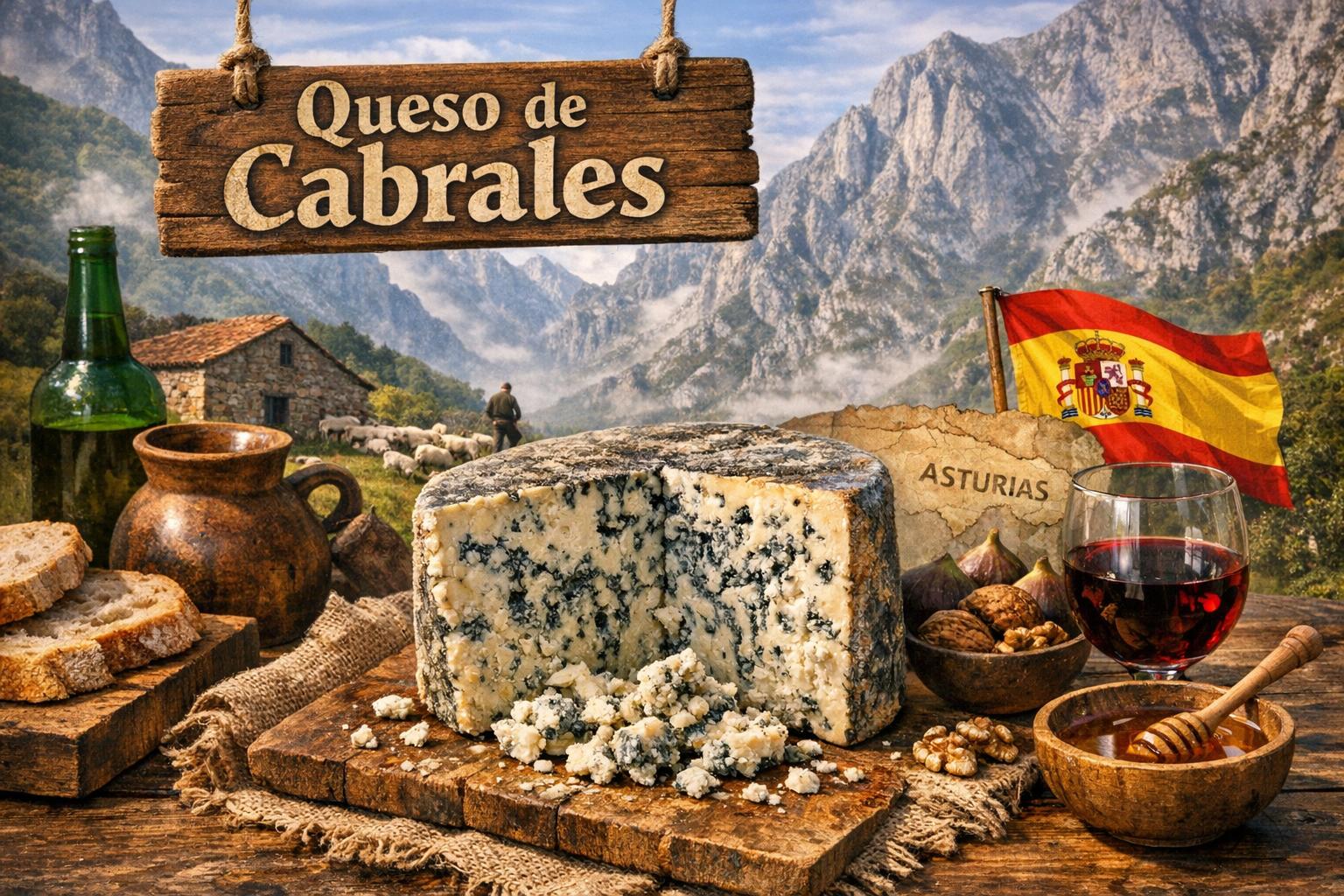
Queso de Cabrales is one of Spain’s most distinctive blue cheeses, originating in the autonomous community of Asturias in the country’s northernmost coastal region. Its production is centered in the municipality of Cabrales and several nearby villages located within the rugged landscape of the Picos de Europa mountains. The geographical isolation of this area, combined with its humid Atlantic climate, has shaped both the agricultural practices and the cheese-making traditions that define Cabrales.
The origins of Queso de Cabrales are closely tied to the pastoral culture of the region. For centuries, local farmers have practiced transhumance, moving livestock between lowland pastures in winter and high mountain grazing areas during warmer months. This seasonal movement allowed animals to feed on a diverse range of grasses and herbs, which in turn influenced the composition and flavor of the milk. Over time, cheese production became an effective method of preserving excess milk in a region where refrigeration was historically unavailable.
Traditionally, Cabrales was produced on small family farms using raw milk from cows, sheep, and goats. While cow’s milk now predominates in many modern productions, especially due to changes in herd composition, mixtures of two or three types of milk are still used and remain highly valued. The blend of milks contributes to the complexity of the final product, influencing its fat content, texture, and aromatic properties. Each farm historically developed subtle variations, shaped by herd management practices, seasonal milk variations, and cave conditions.
The geography of Cabrales plays a central role in the cheese’s development. The Picos de Europa mountains rise sharply above deep valleys, creating a landscape filled with natural limestone caves. These caves are not artificially constructed for cheese aging; rather, they are natural formations that have been adapted for maturation purposes. Their internal climate, marked by consistently cool temperatures and high humidity levels, provides ideal conditions for the slow ripening of blue cheese.
The microclimate within these caves is particularly important. Temperatures typically range between 8°C and 13°C, with humidity often exceeding 90 percent. Such conditions limit excessive drying while encouraging the controlled growth of Penicillium molds. Unlike industrial blue cheese production, where mold spores may be introduced in tightly regulated environments, Cabrales relies significantly on the natural microbial ecosystem of the caves. This unique environment contributes to variations in each batch and reinforces the connection between the cheese and its place of origin.
The surrounding landscape also influences livestock feeding patterns. The varied vegetation found in high-altitude meadows provides animals with a diet that can subtly affect milk composition. Differences in altitude, rainfall, and soil mineral content can all contribute to the sensory characteristics of the final cheese.
The production of Queso de Cabrales begins with fresh raw milk, typically collected daily. The milk is gently warmed and coagulated using natural or selected animal rennet. Once coagulation occurs, the curd is cut into small pieces to facilitate the separation of whey. This step influences the final texture by controlling moisture retention within the curd mass.
After the whey is drained, the curds are placed into cylindrical molds without pressing. This absence of pressing distinguishes Cabrales from many other firm cheeses and contributes to its slightly crumbly yet creamy interior. The cheeses are then salted, either by dry salting or by applying salt directly to the surface over several days. Salting serves multiple purposes: it enhances flavor, regulates moisture, and helps control microbial development.
Following salting, the cheeses are transferred to natural caves for maturation. During the early stages of cave aging, the cheeses are periodically turned and pierced with needles or small rods. Piercing allows oxygen to enter the interior, enabling the growth of Penicillium molds that form the characteristic blue-green veins. Over a minimum maturation period of approximately two to four months, biochemical transformations occur. Proteins break down into peptides and amino acids, while fats are partially decomposed into fatty acids, contributing to the cheese’s complexity.
The cave-aging period is carefully monitored by producers. Although the environment is natural, experienced cheese-makers adjust placement within the cave and turning frequency to influence airflow and humidity exposure. These subtle decisions help determine the intensity of veining and the firmness of the paste.
The defining characteristic of Cabrales is its internal network of blue-green veins, created by strains of Penicillium mold. These molds metabolize fats and proteins during ripening, producing aromatic compounds such as methyl ketones and free fatty acids. The breakdown of casein proteins contributes to the creamy consistency that develops despite the cheese’s relatively firm structure at the outset.
Unlike pasteurized milk cheeses, traditional Cabrales retains its native microflora due to the use of raw milk. This contributes to a broader spectrum of microbial interactions during maturation. The cave environment adds further microbial diversity, resulting in subtle variations between producers and even between different caves in the same region. These microbiological processes account for the complex aroma, which can include notes associated with fermentation, earthiness, and dairy richness.
Moisture content and fat percentage also shape the final product. Mixed-milk versions often display greater aromatic intensity due to the higher fat and protein variability contributed by sheep and goat milk. Goat milk may add sharper acidic tones, while sheep milk often enhances richness and mouthfeel.
Queso de Cabrales is recognized for its pronounced flavor profile. The taste is typically strong, saline, and persistently spicy, with a distinct sharpness derived from mold activity. The level of intensity varies depending on the type of milk used, the duration of maturation, and cave-specific conditions. Mixed-milk Cabrales frequently exhibits a deeper and more layered flavor than versions made exclusively from cow’s milk.
The texture can range from semi-firm and crumbly to creamy and spreadable, particularly when the cheese approaches full ripeness. The paste is ivory to pale yellow, intersected by irregular veins of blue and green mold. Proper maturation yields a balanced structure in which the interior remains moist without becoming overly soft.
Aroma plays a significant role in the perception of flavor. Cabrales typically presents a pungent scent that reflects its mold development and fermentation processes. Although the aroma may be assertive, experienced consumers recognize differences between well-aged cheese and cheese that has exceeded optimal ripeness.
Within Spanish gastronomy, Cabrales occupies a distinct role due to its concentrated flavor. It is commonly served in small portions, allowing its intensity to complement rather than dominate a dish. In its region of origin, it may be consumed with rustic bread or accompanied by local cider, which provides acidity that balances the cheese’s richness.
Cabrales is also frequently incorporated into sauces. A traditional preparation involves melting the cheese with cream or cider to create a dense sauce served over beef, pork, or poultry. The cheese’s salt and mold-driven tang enhance the flavor of grilled meats and roasted vegetables. In some Asturian dishes, Cabrales is used to enrich stews or bean-based preparations.
Despite its strong flavor, Cabrales can also pair effectively with sweet elements. Pears, figs, or quince paste offer a mild contrast to the cheese’s sharpness. In contemporary culinary settings, chefs may crumble Cabrales into salads or incorporate it into fillings, where small quantities provide significant aromatic impact.
Proper storage and serving conditions are important. The cheese is typically served at room temperature to allow its aromatic compounds to become fully perceptible. When stored, it should be wrapped in breathable material to maintain moisture while preventing excessive drying.
Queso de Cabrales holds the status of Denomination of Origin (in Spanish, Denominación de Origen Protegida, DOP), a certification that legally protects its name and method of production. This designation restricts the use of the term “Cabrales” to cheese produced within designated municipalities of Asturias and in accordance with regulated standards.
The regulatory framework specifies acceptable milk sources, production techniques, and maturation conditions. It also establishes quality control mechanisms, including periodic inspections of dairies and caves. Each certified cheese is marked to confirm its authenticity, offering traceability from producer to consumer.
Geographical protection serves multiple functions. It preserves traditional knowledge, prevents imitation products from misleading consumers, and sustains rural economies by adding value to local agricultural practices. At the same time, the designation encourages consistency while allowing for limited individual variation that reflects the natural diversity of caves and herds.
The recognition of Cabrales within broader European Union frameworks aligns it with other protected regional cheeses. Such legal structures emphasize the connection between agricultural products and their geographic environments, reinforcing the importance of environmental specificity in traditional food production.
Queso de Cabrales represents a sustained interaction between landscape, livestock management, microbiology, and human expertise. From its origins in the mountainous terrain of Asturias to its maturation in limestone caves, each stage of production contributes to a cheese defined by intensity and complexity. Its strong flavor, distinctive veining, and reliance on natural cave aging distinguish it from other blue cheeses produced in controlled industrial environments.
As a protected product under the Denomination of Origin system, Cabrales continues to embody regional heritage while adapting to modern regulatory standards. Its enduring presence in Spanish cuisine and international markets reflects both the resilience of traditional methods and the distinctive qualities derived from its specific geographic context.