
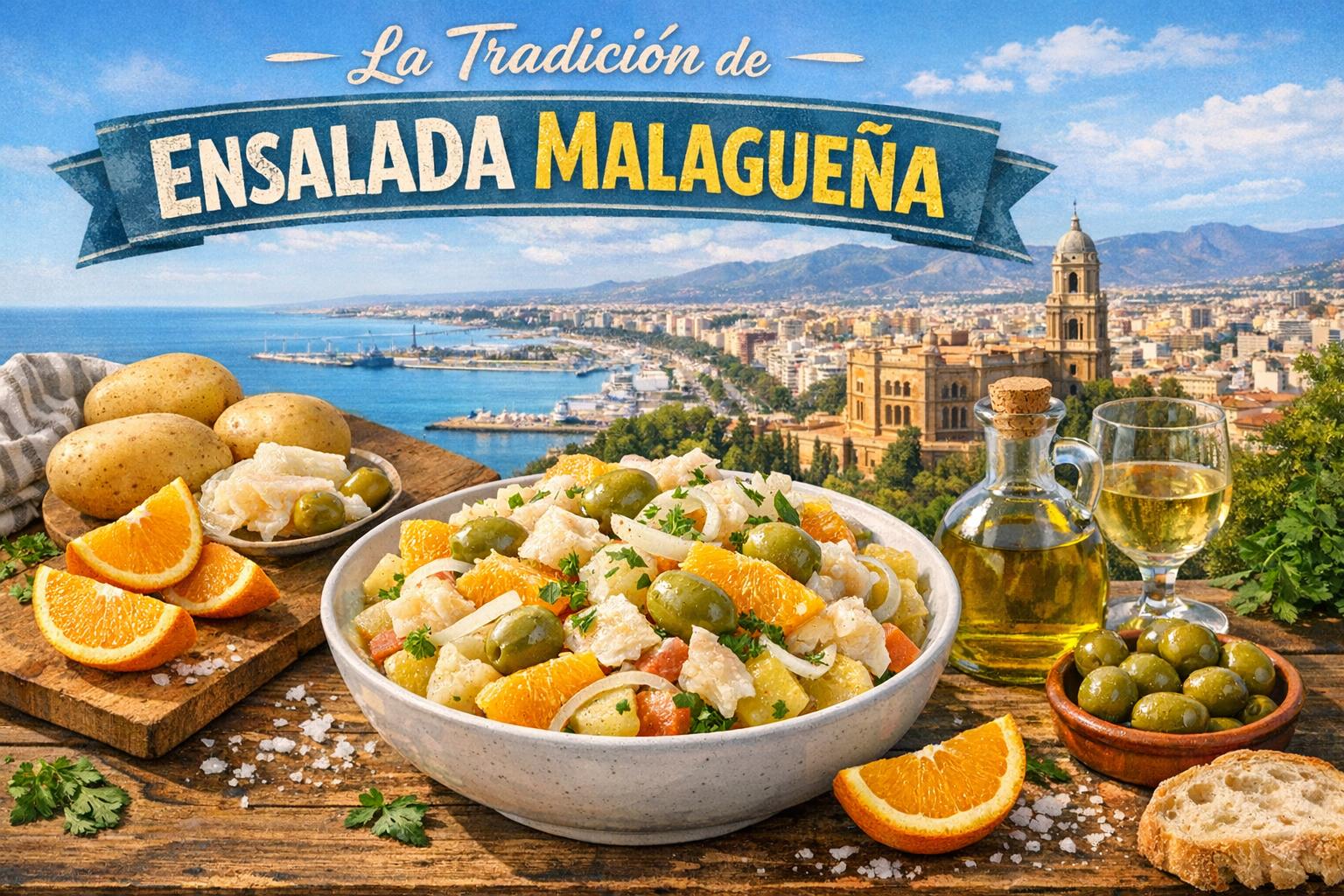
Ensalada Malagueña is a traditional salad originating from the province of Málaga in the autonomous community of Andalusia, located in southern Spain. Its composition reflects the agricultural and maritime landscape of the region, uniting products from inland farms and the Mediterranean coast in a single preparation. The dish is widely regarded as an example of how Mediterranean dietary principles—based on seasonal produce, preserved fish, olive oil, and simple preparation techniques—have shaped local gastronomy over centuries.
The history of Ensalada Malagueña cannot be separated from the broader historical development of Andalusia. The region’s long agricultural tradition, influenced by Roman cultivation methods and later refined under Islamic rule, established systems of irrigation and citrus farming that are still visible today. Oranges, in particular, became an important crop due to the favorable climate, marked by mild winters and long, warm seasons. At the same time, fishing communities along the Costa del Sol relied on preservation techniques such as salting to store and transport fish, including cod.
The salad likely formed as a pragmatic combination of accessible ingredients rather than as a formally documented recipe. Boiled potatoes provided sustenance and caloric density, salted cod offered protein with a long shelf life, and citrus fruit introduced freshness and acidity. Olive oil, produced in large quantities in Andalusia, served as both condiment and preservative. Over time, these elements coalesced into a recognizable regional preparation associated specifically with Málaga and its surrounding towns.
Unlike elaborate ceremonial dishes, Ensalada Malagueña developed as everyday food. It was prepared in households where seasonal availability determined the menu. Its reliance on durable staples such as salted cod and potatoes made it practical for both rural families and coastal workers. Through repetition across generations, the method became standardized, though it still allows for individual variation.
The topography of Málaga province combines mountainous terrain with fertile valleys and access to the Mediterranean Sea. This variety enabled diverse forms of food production. Inland areas were suitable for olive groves and citrus orchards, while coastal zones supported fishing economies. The integration of these resources is visible in many local recipes, but Ensalada Malagueña represents one of the clearest examples of this integration.
Citrus cultivation expanded significantly during the medieval period. Irrigation systems introduced under Islamic governance enhanced agricultural productivity and allowed for systematic orchard development. The orange varieties grown in Málaga tend to be aromatic and balanced in sweetness and acidity, characteristics that suit both desserts and savory dishes. In this salad, orange segments are used not as garnish but as a structural component that influences the flavor profile of the entire preparation.
Olive oil production is another defining feature of Andalusian agriculture. The oil used in Ensalada Malagueña is typically extra virgin, offering a rounded texture and herbal notes. Rather than masking other ingredients, it acts as a unifying medium. The mild bitterness and fruitiness of the oil complement both the citrus and the fish.
The foundation of Ensalada Malagueña consists of boiled potatoes. Introduced to Spain after contact with the Americas, potatoes gradually became a staple ingredient due to their adaptability and nutritional value. In this salad, they are cooked until tender but firm enough to retain structure when mixed. Their neutral flavor serves as a base against which the more pronounced elements stand out.
Oranges provide contrast in multiple dimensions. Their juice lightly permeates the potatoes, contributing subtle sweetness and acidity. The segmented fruit introduces moisture and visual distinction, while the natural sugars counterbalance the savory components. In many traditional preparations, care is taken to remove all pith and seeds to avoid bitterness.
Salted cod, known in Spain as bacalao, is another essential element. Although cod is not native to the Mediterranean, it became integrated into Spanish cuisine through trade networks reaching the North Atlantic. The salting process preserved the fish during transport and storage, making it accessible even in inland communities. In the context of Ensalada Malagueña, cod is typically desalted and then either gently poached or flaked raw after soaking, depending on family tradition.
Green olives are commonly added to introduce a slightly bitter, briny accent. The olives used are often locally cured varieties, which maintain firmness and mild saltiness. Their presence reinforces the agricultural identity of the dish.
The preparation of Ensalada Malagueña requires attention to timing and proportion rather than technical complexity. Potatoes are first boiled in salted water until they can be easily pierced with a knife. Overcooking is avoided to prevent a grainy texture. Once drained and cooled sufficiently to handle, they are peeled and cut into evenly sized pieces to ensure consistent distribution.
Salted cod must be desalted in advance. The fish is submerged in cold water for at least twenty-four hours, with the water changed several times. This gradual process reduces salinity while preserving firmness. After desalting, the cod may be gently simmered for a few minutes or simply flaked if sufficiently tender. The goal is to achieve a clean flavor that complements rather than dominates the salad.
Oranges are peeled carefully, and the segments are separated with a sharp knife. Removing the membranes improves texture and prevents excessive bitterness. The juice released during cutting is often reserved and incorporated into the dressing.
Once the individual components are prepared, assembly follows a straightforward procedure. Potatoes are placed in a large bowl, followed by flaked cod and orange segments. Green olives are distributed evenly to ensure balance in each serving. Thinly sliced onion may be added for sharpness, though its use varies across households. When included, the onion is sometimes soaked briefly in cold water to temper its intensity.
The dressing typically consists of olive oil, a small quantity of wine vinegar, and salt as needed. Because the cod and olives already contribute salinity, additional salt is used sparingly. The ingredients are combined gently to avoid breaking the potato pieces. Resting the salad for a short period before serving allows flavors to integrate and excess moisture to settle.
Hard-boiled eggs are a common optional addition. When used, they are sliced and arranged either mixed into the salad or placed on top. Their neutral richness provides textural variety and enhances visual presentation without altering the foundational character of the dish.
Ensalada Malagueña is frequently prepared during warmer months, when citrus fruit is abundant and lighter dishes are preferred. It is typically served at room temperature, which makes it suitable for communal meals and outdoor gatherings. Its composition allows it to function as either a main course or a side dish accompanying grilled meats or seafood.
Within domestic settings, the salad may appear on tables during religious observances or local festivals, although it is not restricted to specific holidays. Because it contains fish, it has historically been aligned with periods of abstinence in the Christian calendar when meat consumption was limited. The reliance on preserved cod made it accessible even outside peak fishing seasons.
In restaurants throughout Málaga, Ensalada Malagueña often features as part of a menu highlighting regional identity. While presentation styles vary, the essential combination remains recognizable. The dish reinforces continuity between household cooking and professional gastronomy.
Beyond its ingredients, Ensalada Malagueña represents a synthesis of historical influences. The incorporation of citrus reflects agricultural developments spanning centuries. The presence of cod points to maritime trade routes that connected Spain to northern Europe. Olive oil underscores Andalusia’s longstanding role as a major producer within the Mediterranean basin.
The recipe also illustrates principles associated with the Mediterranean diet, including reliance on plant-based components, moderate use of preserved proteins, and emphasis on olive oil as a primary fat source. These characteristics have drawn scholarly interest due to their links with nutritional studies and regional sustainability practices.
Family transmission plays a central role in the preservation of the recipe. Measurements are often approximate, guided by sensory assessment rather than standardized quantities. The process of desalting cod or selecting ripe oranges forms part of culinary knowledge passed through observation and repetition.
Contemporary chefs have introduced variations while retaining the basic identity of Ensalada Malagueña. Some replace salted cod with fresh seafood such as tuna or smoked fish to simplify preparation. Others experiment with different citrus varieties, including blood oranges or mandarins, to modify sweetness and color contrast.
In certain adaptations, additional herbs such as parsley are incorporated for freshness. Vinegar types may vary, with sherry vinegar offering a slightly deeper profile than standard wine vinegar. Despite these adjustments, successful reinterpretations maintain the balance between starch, fruit, and fish that defines the original.
Outside Spain, the salad has gained recognition as part of the broader international interest in Mediterranean cuisine. Its relatively simple preparation and reliance on accessible ingredients make it adaptable for home cooks. However, authenticity is generally associated with the use of quality olive oil, properly desalted cod, and ripe oranges.
In examining Ensalada Malagueña, one observes how regional cuisine emerges from interaction between environment, trade, and tradition. The dish demonstrates how preservation techniques and agricultural abundance can converge in a preparation that remains relevant across generations. Its continued presence in both domestic kitchens and professional settings indicates that simplicity, when supported by thoughtful ingredient selection, can sustain culinary practices over time.
As a representation of Málaga’s gastronomic heritage, Ensalada Malagueña offers insight into the social and economic patterns that shaped southern Spain. Through its integration of coastal and inland elements, it reflects a landscape where sea and orchard coexist. The salad’s endurance suggests that regional foods remain significant not only for sustenance but also for maintaining continuity with the past.