
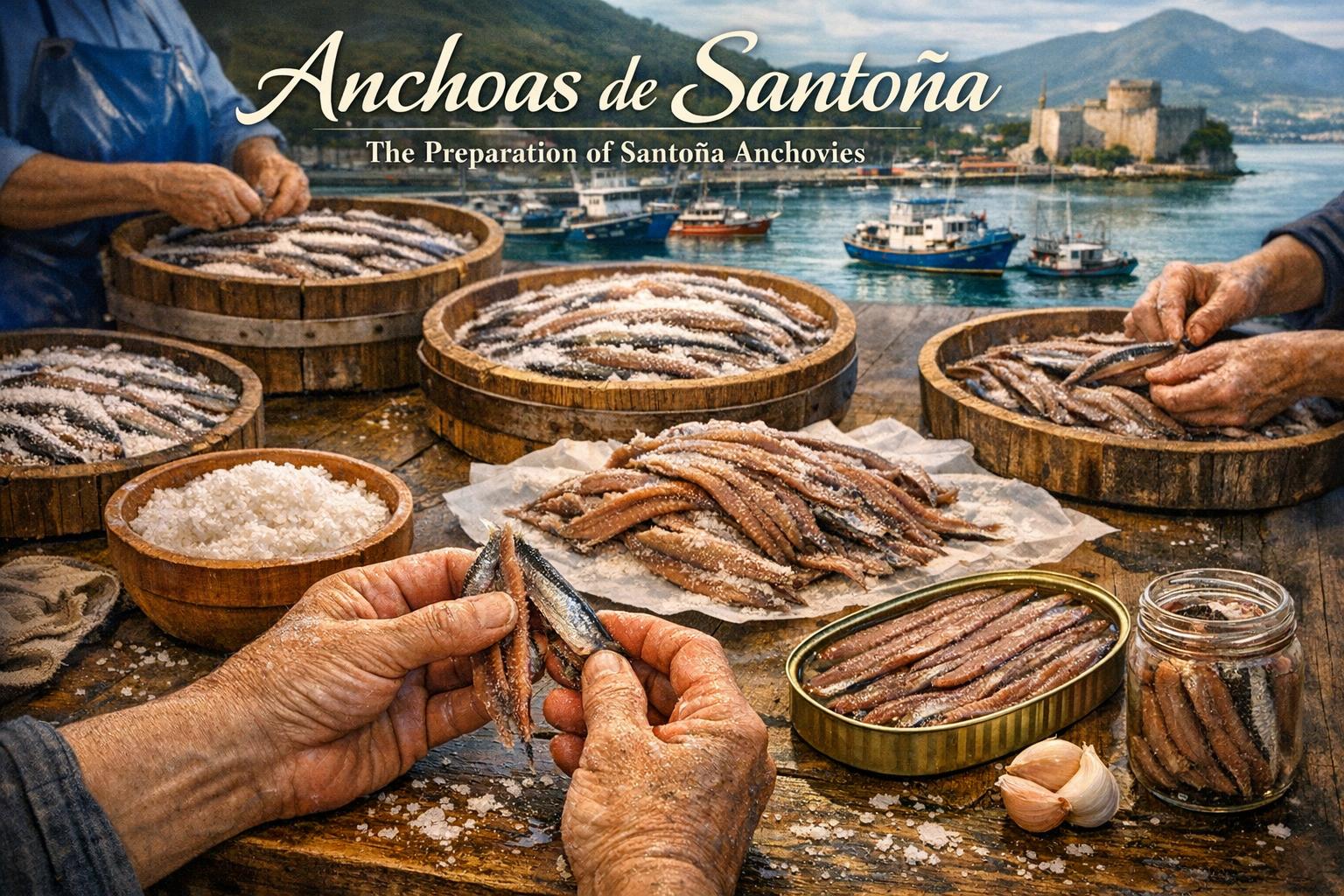
The small coastal town of Santoña, located in the autonomous community of Cantabria in northern Spain, has developed an international reputation for producing some of the finest anchovies available on the market. Positioned along the Bay of Biscay, Santoña benefits from direct access to the Cantabrian Sea, whose cold, nutrient-rich waters create favorable conditions for anchovy populations. Over time, the town’s economy and cultural identity have become closely connected to the sea, particularly to the preparation of anchoas de Santoña.
Although anchovies had long been consumed in the region, the modern method used to produce salted anchovy fillets in Santoña can be traced back to the early 20th century. At that time, Italian fishermen and entrepreneurs, especially those from Sicily and other Mediterranean coastal regions, traveled along the northern Spanish coast following anchovy migrations. They introduced specialized preservation techniques, including controlled salting and long curing processes, that transformed the handling of the local catch. These Italian methods were gradually adopted and refined by local producers.
Prior to this influence, anchovies were commonly preserved in salt for bulk consumption, often destined for inland markets. The Italian approach emphasized careful maturation and hand preparation intended for direct consumption as fillets. This shift marked the beginning of Santoña’s distinctive anchovy industry. Over decades, families in the town established small-scale processing facilities, many of which continue to operate today. Their accumulated expertise contributed to the development of standards that distinguish anchoas de Santoña from other preserved anchovy products.
The production of Santoña anchovies begins at sea with the capture of the European anchovy (Engraulis encrasicolus), a species widely distributed throughout the eastern Atlantic and Mediterranean. The Cantabrian Sea is particularly valued for producing anchovies with a balanced fat content and consistent size, qualities that are essential for the salting and curing process.
The primary fishing season typically extends from April to late June. During this period, anchovies migrate closer to the coast for spawning. At this stage of their life cycle, they have accumulated sufficient fat reserves, which directly affect flavor, texture, and overall quality. Fish caught outside this peak season may not exhibit the same depth of flavor or structural integrity when cured.
Fishermen operating out of Santoña rely largely on purse seine nets. This method involves encircling a school of fish with a large net that is then drawn closed at the bottom, resembling a drawstring pouch. Purse seining is considered an efficient and relatively selective fishing technique, as it allows crews to target specific schools and reduce unintended bycatch. Over the years, regulatory frameworks at both national and European levels have established quotas and seasonal limits to prevent overfishing and to promote long-term sustainability of anchovy stocks.
Once captured, the anchovies are handled with care to prevent physical damage. Because they are small and delicate fish, improper handling can affect the final presentation of the fillets. The catch is quickly transported to port, often within hours, to preserve freshness and begin the processing sequence without unnecessary delay.
Upon arrival at processing facilities in Santoña, the anchovies undergo a detailed sorting and cleaning process. Workers first inspect the fish to ensure uniformity in size and quality. Consistency is important, as similar-sized anchovies cure at comparable rates, which contributes to a homogeneous final product.
The cleaning stage involves removing the head and viscera of each fish. This task requires both speed and precision. After evisceration, the anchovies are thoroughly washed to eliminate blood, scales, and other residual impurities. Hygiene standards are strictly maintained throughout this phase to ensure food safety and product stability.
Following cleaning, the fish are prepared for salting. Large barrels or metal containers are lined with coarse sea salt, and a layer of anchovies is placed carefully inside. This is followed by another layer of salt, then another layer of fish, creating alternating strata. The process continues until the container is filled. A weighted lid is applied on top to compress the layers.
Salt serves multiple functions. From a preservation standpoint, it draws moisture out of the fish through osmosis, inhibiting the growth of spoilage-causing microorganisms. At the same time, it initiates biochemical transformations within the anchovy flesh. Enzymatic reactions gradually modify proteins and fats, contributing to the development of complex savory flavors. The compression also helps to shape the fish into a uniform form, facilitating later processing steps.
After salting, the anchovies enter a curing stage that typically lasts between six and ten months. The length of maturation depends on factors such as fish size, fat content, and the specifications of individual producers. During this time, the barrels are stored in facilities where temperature and humidity are carefully controlled. Stable environmental conditions are essential to ensure consistent curing and to prevent spoilage.
Throughout the maturation period, the fish remain under pressure from the weighted lids. The salt continues to penetrate the flesh, while natural enzymes break down proteins into amino acids and other compounds that enhance flavor. This slow transformation is central to the identity of anchoas de Santoña. Unlike fresh anchovies or lightly marinated white anchovies, which are preserved in vinegar, salted and cured anchovies acquire a denser texture and a darker coloration.
Periodic inspection is conducted to monitor the progress of maturation. Producers may adjust pressure or remove excess liquid that accumulates in the barrels. Experience plays an important role during this phase, as determining the optimal endpoint of curing requires knowledge developed over years of production.
When maturation is complete, the anchovies display a firm yet supple texture. The flesh separates cleanly from the central spine, and the flavor profile shows a balanced salinity combined with pronounced umami notes. Only at this stage are the fish considered ready for final preparation.
The transformation from salted fish to finished fillets involves several labor-intensive steps, many of which are performed manually. First, the cured anchovies are removed from their barrels and rinsed carefully to eliminate surface salt. Excess salt must be removed without washing away the flavor that has developed during curing.
After rinsing, each anchovy is split open and filleted. Skilled artisans, often referred to locally as sobadoras, use small knives and precise hand movements to remove the central spine and any remaining bones. This delicate work is critical to maintaining the structural integrity of each fillet. Mechanical deboning methods exist, but for high-quality Santoña anchovies, manual processing remains standard because it allows for greater control and visual inspection.
The fillets are then trimmed to ensure uniformity. Any darkened areas caused by prolonged contact with blood are removed to improve appearance and taste. Once cleaned and shaped, the fillets are dried briefly to eliminate excess moisture before packaging.
Packaging traditionally involves arranging the fillets neatly in small tins or glass jars. They are typically covered in olive oil, which serves to protect the anchovies from air exposure and oxidation. Olive oil also contributes subtle flavor notes and helps maintain a tender texture. Some variations may incorporate other oils, but high-quality olive oil is commonly preferred for premium products.
After sealing, the packaged anchovies may rest for an additional short period to allow flavors to integrate. Properly stored, they can maintain their quality for an extended time. However, once opened, refrigeration is necessary, and the fillets should remain submerged in oil to preserve their condition.
Over the years, Santoña has established itself as a benchmark for anchovy production. The term anchoas de Santoña is used to denote anchovies that have been processed according to specific regional practices. Although anchovies may be caught in various parts of the Cantabrian Sea, the preparation methods employed in Santoña are central to the product’s identity.
Quality is assessed based on several criteria, including size consistency, color, texture, and flavor balance. High-grade fillets exhibit a reddish-brown hue, a smooth surface, and a clean, savory taste without excessive bitterness. Uniformity in packaging and careful alignment of fillets are also considered indicators of craftsmanship.
The industry in Santoña consists largely of small to medium-sized family businesses. Knowledge is often transmitted across generations, contributing to continuity in technique. While modern equipment has improved hygiene and efficiency, many core steps remain rooted in manual skill and observation.
Santoña anchovies are consumed both domestically and internationally. In Spain, they are commonly served as part of tapas, placed atop bread with butter, tomatoes, or roasted peppers. Their concentrated flavor makes them suitable for enhancing sauces, dressings, and cooked dishes. Because they are already cured and preserved, they require no additional preparation beyond simple presentation.
International markets have also recognized the distinction between standard preserved anchovies and those produced in Santoña. As global interest in traditional and regional foods has expanded, so has demand for products that reflect identifiable origins and established methods. The reputation of anchoas de Santoña rests on consistency, traceability, and craftsmanship rather than mass production.
The preparation of anchoas de Santoña represents a structured and carefully managed process that begins with seasonal fishing in the Cantabrian Sea and concludes with the meticulous hand-packaging of cured fillets. Each stage—selection, cleaning, salting, maturing, deboning, and packaging—contributes to the development of the final product.
What distinguishes Santoña anchovies is not a single step but the cumulative effect of regional knowledge, environmental conditions, and sustained attention to detail. Through the integration of early 20th-century Italian preservation methods and local maritime traditions, Santoña has established a model of anchovy production that continues to define quality standards. The result is a preserved seafood product recognized for its balanced flavor, firm texture, and consistent presentation across markets worldwide.